CyberRISE Program · PRACTITIONER CLARITY

Bringing Clarity to Cybersecurity
Frameworks

Cybersecurity frameworks tell you what to do. They don't tell you how. Framework Maps breaks each control into its core requirement, supporting elements, and implementation steps — then maps them to the tools you already use. Currently available: CIS Controls v8.1 — all 153 safeguards fully mapped.
153
Safeguards Mapped
1
Framework Complete
CIS v8.1
First Map
NIS2
Next on Roadmap
Why Framework Maps Exists

Frameworks are essential for managing risk

They are also abstract by design — written to be broadly applicable, not specifically actionable. Practitioners are left bridging the gap between what a control says and what they actually need to do, with which tools, in which order.

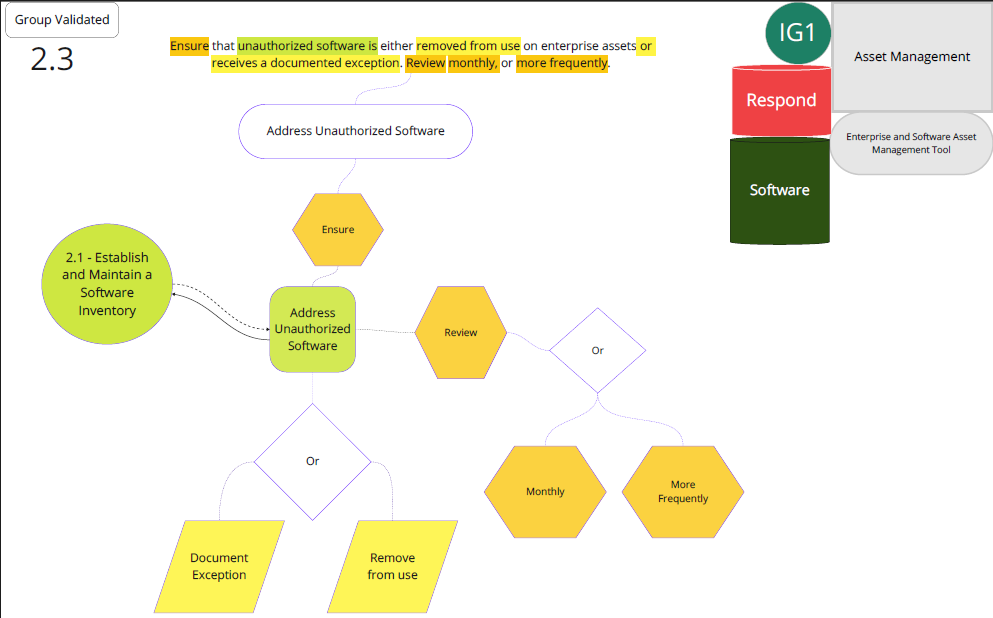
Framework maps CIS v8.1 diagram
The gap we're built to close

Framework Maps closes that gap

Every safeguard decomposed. Every relationship visualized. Every map reviewed by practitioners. Theory becomes implementation.

01

Frameworks Are Abstract

Controls are written to be broadly applicable — which means they aren’t specifically actionable for any one environment.

02

Implementation Is Concrete

Practitioners need to know what tool, what configuration, what evidence — not just what the control says.

03

The Gap Wastes Effort

Bridging that gap consumes thousands of practitioner hours per organization. Framework Maps does it once, openly, for the community.

Our Mission

Framework Maps translates complex cybersecurity frameworks into clear, visual, and actionable guidance that helps practitioners move from theory to confident, repeatable implementation.

The Deliverable

What Framework Maps Gives You

Each map breaks a control down into the components a practitioner actually needs. This isn’t compliance theater. It’s implementation clarity.

Core Requirement

What the control is actually asking for — stripped of ambiguity, written so a practitioner can act on it.

Supporting Elements

What else needs to be in place. Dependencies, prerequisites, related controls. The full picture, not just the headline.

Implementation Steps

How to get from zero to covered. Practical, sequenced, executable.

Vendor / Product Mappings

Which tools in your stack address which elements — so you can validate coverage and identify real gaps.

Who this is for

Built by practitioners, for practitioners.

01

Cybersecurity Practitioners

The primary audience. Engineers, analysts, architects, and consultants implementing controls in real environments.

02

Organizations Implementing Frameworks

Security teams adopting CIS, NIS2, or comparable frameworks who need clarity, not just citations.

03

MSPs & Security Leaders

Service providers and CISOs validating control coverage across their stack — and identifying real gaps.

04

Educators

Cybersecurity programs using maps to teach implementation — not just compliance.

How we measure impact

Framework Maps impact is measured through practitioner adoption, clarity of framework interpretation, and feedback from real-world implementations.

Impact is reviewed periodically and refined as mappings evolve. Map downloads are tracked. Practitioner feedback shapes the next iteration.

The Bigger Picture

Part of the CyberRISE Ecosystem

Framework Maps is one of three programs operated by CyberRISE, a 501(c)(3) nonprofit dedicated to strengthening the cybersecurity ecosystem. The Hackening builds the talent pipeline. Framework Maps strengthens practitioner clarity. MSP911 supports MSPs in active incidents. Three programs. One mission.

Be Part of the Mission

Framework Maps is built by practitioners, for practitioners. Use the maps. Contribute to them. Help expand to new frameworks.