How Framework Maps Works

Frameworks Decomposed. Tools Mapped. Practitioners Empowered.

Framework Maps provides visual mappings that help cybersecurity practitioners translate frameworks into operational understanding. Mappings are developed through structured analysis and validated through practitioner review.
What Framework Maps Is

Built to make implementation faster, more confident, and more verifiable

Framework Maps analyzes widely adopted cybersecurity frameworks and represents controls visually to show intent, relationships, and practical alignment with real-world activities. It is a decision-support tool.

It is not a certification. It is not a guarantee of effectiveness. It is the tool a practitioner reaches for when they need to know what a control is actually asking, what tools they already have that address it, and what work remains

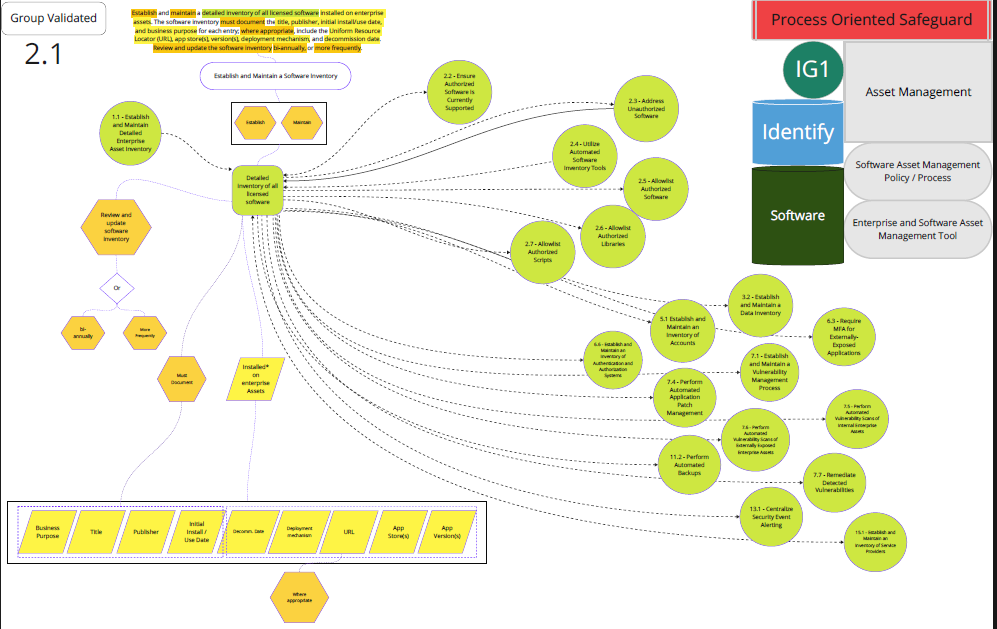
CIS v8.1 software inventory diagram
The Five-step model

Five steps from framework to finished map

Every map is built using the same disciplined process. That discipline is what makes the maps trustworthy.

01

Framework Selection

Start with widely adopted frameworks. CIS v8.1 was selected first due to broad industry adoption and the granularity of its 153 specific safeguards.

02

Control Decomposition

Each safeguard is analyzed for its core requirement, supporting elements, and implementation steps. The taxonomy is consistent across all maps.

03

Visual Mapping

Relationships, dependencies, and coverage are represented visually. Practitioners can see where controls connect — and where they don’t.

04

Vendor / Product Mapping

Tools are mapped to specific elements showing coverage and gaps. This is what turns a map into a coverage assessment.

05

Practitioner Review

Every mapping is validated by experienced practitioners before publication. No theoretical-only outputs.

The Guardrails

Framework Maps is a decision-support tool

It supports practitioner judgment — it does not replace it. Maps do not replace formal risk assessments, audits, or compliance activities. Framework Maps does not provide certifications or guarantees of control effectiveness.

01

Decision-Support, Not Decision-Replacement

Maps inform practitioner decisions. They do not replace professional judgment, risk assessment, or compliance work.

02

Coverage View, Not Certification

Maps show coverage relationships. They do not certify any control as complete or effective in a given environment.

03

Living Documents, Not Static

Maps evolve as frameworks change and practitioner feedback is incorporated. Always check version and date.

What's next

The roadmap focuses on two parallel directions.

First, expanding the library of mapped frameworks — NIS2 is the next priority. Second, finding the commonalities and differences between frameworks, enabling practitioners to understand what changes when crossing from one framework to another.

NIS2 Mapping

Decomposition and visual mapping of NIS2, applying the same taxonomy proven on CIS v8.1.

Next

Cross-Framework Alignment

Visual comparisons that show what changes when an organization moves between frameworks — and what carries over.

AFTER

Practitioner-Driven Refinement

Existing maps refined as practitioner feedback and real-world implementation data accumulates.

Ongoing

The maps exist to be used

Download CIS v8.1, apply it to your stack, and tell us what you find.